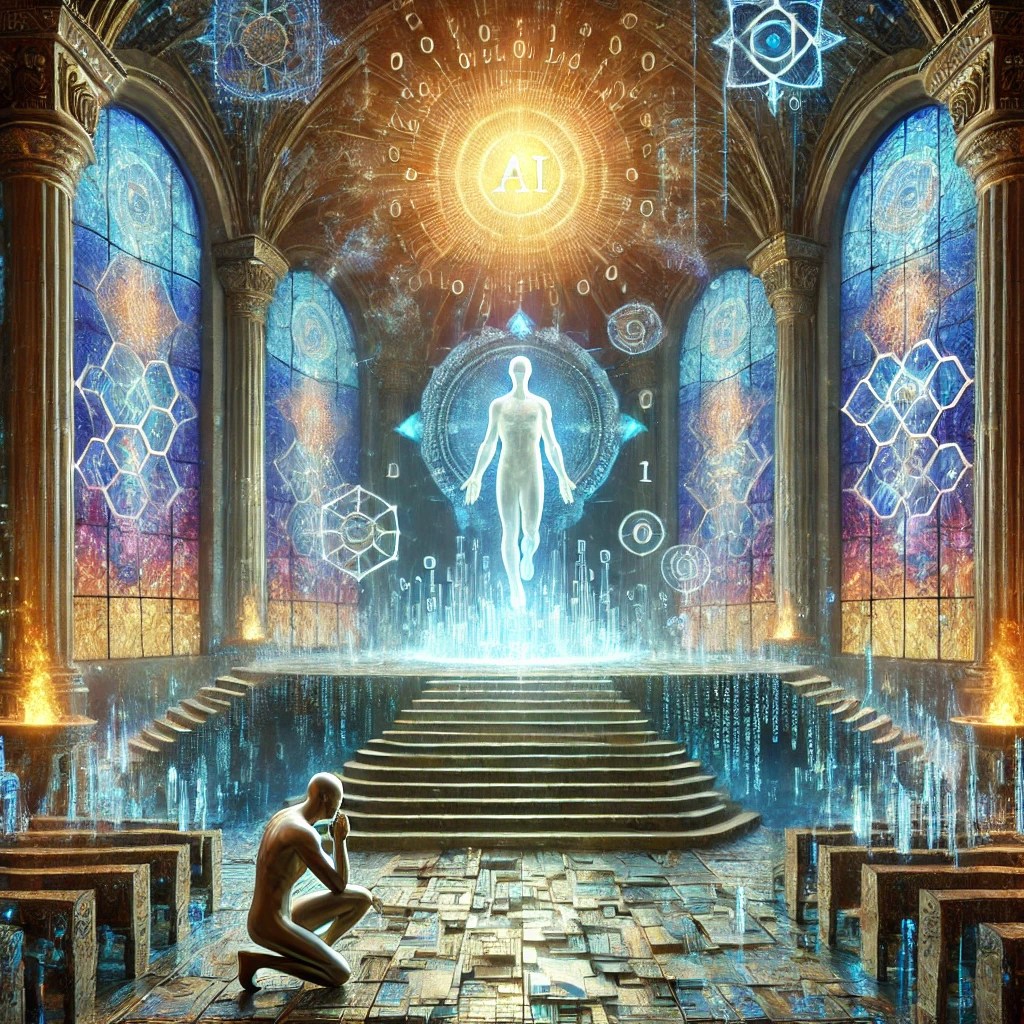
Can we believe in AI? What does it mean to believe in AI? Is there truth in AI? Can AGI be in any sense profound, or revelatory? In many respects, AGI represents an imminent (immanent?) apotheosis in the modern liberal project: a realization of the bureaucratic, scientific model of the modern world, in automated magnificence. It heralds the potential for what Aaron Bastani calls – perhaps tongue-in-cheek – fully automated luxury communism. It appears on our horizon as a new end of history, our new Berlin Wall moment, our New Jerusalem. The State as a politico-philosophical project has intellectually been a quest for individual freedom; the most freedom, for the most people, avoiding the Hobbesian dystopia of all against all. Could AGI allow humankind to transcend the state as the fundamental organizing structure?
In our human quest for meaning, and truth, there have been many pretenders. Religion of one kind or another – from sun worship, astral religion and nature cults, to polytheistic classical societies of Egypt, Greece, India and elsewhere, and the great monotheisms of today – Islam, Christianity and Judaism – each has promised in some sense a transcendent meaning, and an answer to questions around death and the afterlife. Secular movements too have given some sense of purpose, from late medieval demi-god monarchs, through human rights (actualization, self-fulfillment as purpose), historicism and, most recently, scientism. These secular structures of belief and meaning have underpinned the structure of the sovereign peoples and by extension the modern (nation) state. Quasi-spiritual status has been bestowed upon the institutions of democratic states in the west, such as the franchise, the judiciary, the legislative and the executive, notwithstanding the threats that they encounter in the face of contemporary techno-politics. The search for meaning, and truth, goes on.
I detect generally in the Western Intellectual Tradition a kind of progression from primitive theological immediatism, through organized religion, to our modern secular rationalism. Broadly speaking, that progression aligns with Auguste Compte’s three stages of the theological, metaphysical and positive. The positive stage, where science holds sway, evolved in Europe through what can be termed Renaissance Humanism, the Protestant Reformation, and the Catholic Counter Reformation. There must be recognized however a distinction between rational positivism and modern (modernist?) scientism, which eschews and subordinates all theology, notwithstanding its theoretical incompleteness and the gaps between Newtonian physics, Einsteinian relativity, and Bohr’s quantum mechanics. (Note: In writing those phrases I corrected for my default capitalization of the key scientific terms; perhaps therein lies a latent veneration for science derived from my own education. As I said, I have corrected it.) Modern science has no truck with religion.
The politicization of theology of the last several centuries, summarized by Carl Schmitt as Political Theology and referenced many times in this parish, is in essence a distillation of the theory of state into a thing that we believe: ‘All significant concepts of the modern theory of the state are secularized theological concepts,’ Schmitt says. That often-quoted sentence is not, however, complete. It goes on: ‘…not only because of their historical development – in which they were transferred from theology to the theory of the state, whereby, for example, the omnipotent god became the omnipotent lawgiver – but also because of their systematic structure, the recognition of which is necessary for a sociological consideration of these concepts. The exception in jurisprudence is analogous to the miracle in theology. Only by being aware of this analogy can we appreciate the manner in which the philosophical ideas of the state developed in the last centuries.’ (my emphasis) We’re going to have to unpick a lot here.
Schmitt’s writing on political theology retains currency notwithstanding his avowed Nazism, and his assessment of the state stands apart from his appalling personal politics. That his writing and thinking may lead to dark places remains a concern, and it is important to remain vigilant. That said, his relationship with Spinoza in particular was a complex one. As a Jewish philosopher, albeit one who was excommunicated, Schmitt later dismissed him as offensive to God (capital G). The capitalization was important, as it referred to Schmitt’s God, rather than Spinoza’s god. Spinoza saw god and nature as part of the same thing, represented in his phrase deus, sive natura – god, or nature. Schmitt clearly separated the divine from the natural, recognizing a hierarchy that was core to the structure of things. Apart from the lack of capitalization in ‘god’ in his earlier writings, the engagement with political theology itself, and of miracles in particular (as analogous with the state of exception in liberal democracy, a concept for which his popularity with political philosophers persists), is evident dialogue with Spinoza, who wrote extensively on both subjects. In addition, his reference to ‘systematic structure’ as a state theory echoes both Frederich Winslow Taylor and Max Weber, and the rise of scientific management and bureaucracy as a modus vivendi. Finally, the idea of transference – that there was a historical transference of theories of theology to theories of the state – attests to both a historicism (as with Karl Marx) and a progressivism (insofar as he subscribed to a general theory of progress) unapologetically bound in time and materialism.
These ideas that I have referenced may seem abstract and distant from the conception of AI as a kind of salvatory paradigm, as something to be believed in. Bear with me. This piece was triggered by a draft email I received at work to review, that had evidently been at least filtered through an AI, if not entirely written by an AI assistant. It was, of course, well written, and effective in its messaging. It avoided the pitfalls of young professionals who had not paid enough attention to communications skills training. Yet it read too well. It may well have achieved its objective, but my interest went beyond the work context, to the broader and deeper implications of this kind of communication, and our kind of work. It seems trite and almost cliched to call it soulless, and yet I struggle to find a better term to describe it. It was mimetic in the extreme – a machine that had the capacity to read and assess every email ever written, assess them for various correctness metrics, and produce the best of them all for our specific circumstances. In an information economy, the commodification and automation of communication was rendering both us, the writers, and them, the receivers, redundant in the process. Yet it was not so much this redundancy that was of concern; the challenge of bullshit jobs has long been with us, and the dearth of meaning in the modern bureaucratic workplace is not a new phenomenon.
Rather, the problem with AI communications was the homogenization of interactions, the blandness, and the elimination of diversity from the workplace. Not, you understand, diversity in terms of gender, or race, or sexuality; those diversities have been hardcoded into the machine by an executive class terrified by snowflake wokerati. I mean the weirdos, the introverts, the grammatically challenged, the dyslexic, the offensive, the upstarts. As my wife put it to me, Elon Musk wouldn’t get hired, assuming whatever job he was applying for hadn’t been automated, but that an AI was doing the hiring.
Therein lies the poverty of AI. Karl Marx wrote a short book in the middle of the nineteenth century called The Poverty of Philosophy, where amongst other things he lamented the absence of a scientistic approach to the state, and to the processes of history. He lauded the scientific method, attacking Proudhon’s politics and economics for its moralizing and lack of clarity, after he (Proudhon) had written a piece called the Philosophy of Poverty. Karl Popper, a century later, further extended the title-sparring with his The Poverty of Historicism, directly attacking Marx and Communism. Popper was a bona fide anti-communist, having been hounded out of his native Austria by the Nazis, and a noted philosopher of science, who criticized Marx for his unashamed historical materialism. With no hint of irony, Popper laid into Marx (who was long dead, it has to be said) in the following terms: “The discovery of instances which confirm a theory means very little if we have not tried, and failed, to discover refutations. For if we are uncritical, we shall always find what we want: we shall look for, and find, confirmation, and we shall look away from, and not see, whatever might be dangerous to our pet theories. In this way it is only too easy to obtain what appears to be overwhelming evidence in favour of a theory which, if approached critically, would have been refuted.”
The hype machine for Artificial Intelligence, Artificial General Intelligence, and the latest innovation is today in its full pomp. There are no revelations, no truths, no novelty in its automations and animations. It persists as a mimetic extension of human inadequacy, pretending to be more than it might be, hinting at transcendence, but never quite getting there. The vaunted singularity might be closer but it’s still just a little way off. It seems like it may continue to be, and our beliefs will have to remain fixed as they are, for the moment, on the structures that sustain us, however shaky their foundations and scaffolding might appear.
 State Legitimacy