Category: Philosophy

Sovereignty, Poverty and Interdependence

sean_lemass_02
Seán Lemass, Taoiseach of Ireland 1959-1966. Lemass believed Ireland had given up its sovereignty to the International Community in the years after World War II.

Ireland has had a well documented, rather turbulent recent economic history.  Following on from the bursting of the property bubble and the attendant banking collapse, an extraordinarily myopic political decision to nationalise the exposure of the banks led to a sovereign debt crisis, and, ultimately, a bailout from the troika of the IMF, ECB and European Commission.  Apart from the loss of money, there was plenty dramatic wailing about the loss of National Sovereignty, and references to the War of Independence and the heroes of 1916 and ‘is this what they died for?’ rhetoric.  There was even a nuance to the sovereignty question, in that the country had lost her economic sovereignty, whatever that meant.

Now, politics has always had an uneasy alliance with the propriety of language, bending it to its will as any situation may have seen fit.  The distinction between economic sovereignty, and other sovereignty, one supposes, is that while we’re not necessarily allowed to award pay rises to civil servants, we are still permitted to invade England.  At least we have that, I guess.   Of course, the extent to which we are – truly – permitted to invade England is limited in exactly the same way as our freedom to spend money has been limited.  It is not a flat prohibition on action through coercive or other power that has limited what Ireland as a State can do; it is the threat of exclusion from international systems upon which we have become irrevocably dependent that limits our action.


Continue reading “Sovereignty, Poverty and Interdependence”

Systemic Issues: Marx, Python, Equality and Capitalist Doom

Karl_Marx_001
Karl Marx. The man had his moments.

Charles Moore’s article in the Telegraph yesterday caused something of a stir. Equality, he said, was not really a good thing at all. What’s that you say? He must be an elitist! How uncool is that! Well, essentially he was arguing that in the context of women in the army, and in particular on the front line of the army, that it was one step too far. Women just are not as strong as men, and therefore shouldn’t be there. His argument weakened when he extended it into civil partnership, defining marriage in terms of the legal structures for its dissolution, which appears to me to be something of a non sequitur. In essence, Moore misses the point that ‘unconventional’ couples are not seeking access to the institution, but rather to its attendant rights; indeed, they are seeking to fundamentally alter the institution, and make it more inclusive, rather than simply more equal.

Continue reading “Systemic Issues: Marx, Python, Equality and Capitalist Doom”

Zizek’s Technological Post-Humanism and Anonymous

anonymous
Anonymous: Abstract Technological Representation of the Excluded

As mentioned in my last post, Zizek identifies four apocalyptic antagonisms that threaten the liberal democratic status-quo.  They are ecology, technology, property and equality.  In relation to the technological post-human dystopia, Zizek attributes a leadership role to Ray Kurzweil, a noted thinker in technology futurism.  There are two kinds of post-humanism, it appears – a kind of robotic, artificial intelligence future as described in the fiction Asimov and the Terminator movies, and a bio-genetic technological Armageddon  of which I’m less familiar.

Continue reading “Zizek’s Technological Post-Humanism and Anonymous”

Global Political Movements

zizek
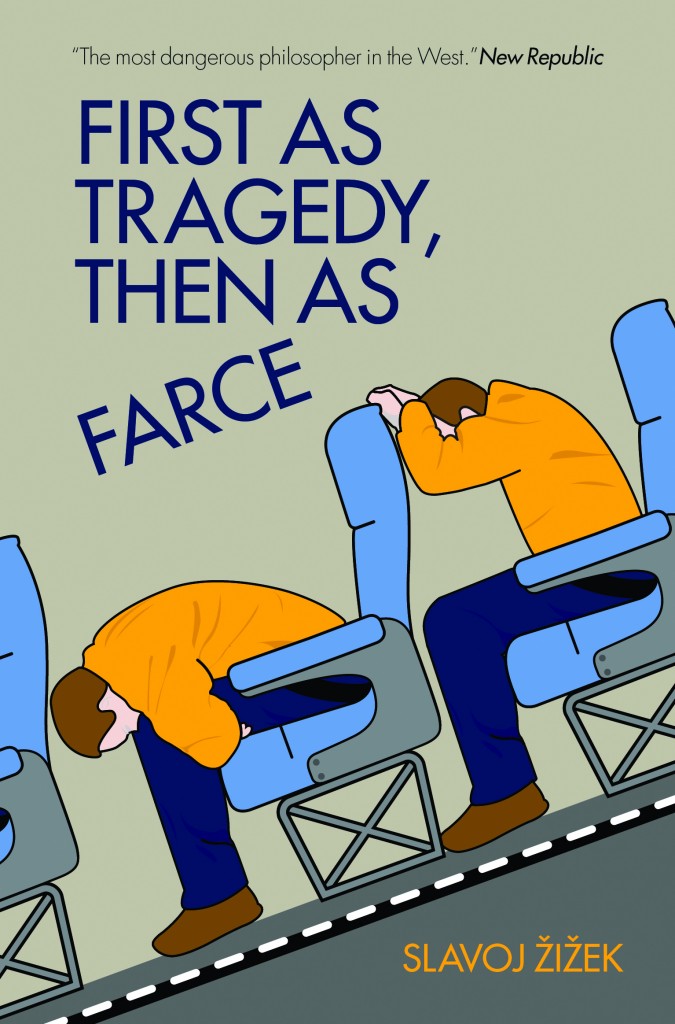
Zizek’s ‘First as Tragedy, Then as Farce’

On the plane to New York I was reading an interesting article in the Economist on The Politics of The Internet, that asked the question whether Internet activism could develop into a ‘real political movement’.  It was an interesting sentence construction, one that presupposed how politics should work, and that the real effect of significant change may not be within the system – in the form of a political party, one that spans borders – but with the system itself.  For example, open source software should not succeed at all based on the market based assumptions of equity distribution.  It succeeds in spite of the system, not because of it.  At the same time, I’m reading Zizek’s First as Tragedy, Then as Farce, notwithstanding his pathological fear of footnotes.

Continue reading “Global Political Movements”

Karl Popper, and Social Probability

I’ve not read much of Popper, a failing I’m looking to rectify soon.  However, one snippit has intrigued me – his assertion that if we can predict a solar eclipse, then we should be able to predict revolutions.  Saying that, I’m not entirely sure if it was an assertion (“…we should be…”) or a question (“…should we be…”).  Nevertheless, our excess of instrumentation today through the integrated digital tooling of everything means that we can measure more than ever before.  With social media, an appropriate big data infrastructure with cutting edge sentiment analytics should be able to measure the pulse of a people.  That’s an experiment I’d like to set up some day, and hopefully I’ll get the time to do it.

Continue reading “Karl Popper, and Social Probability”