On the plane to New York I was reading an interesting article in the Economist on The Politics of The Internet, that asked the question whether Internet activism could develop into a ‘real political movement’. It was an interesting sentence construction, one that presupposed how politics should work, and that the real effect of significant change may not be within the system – in the form of a political party, one that spans borders – but with the system itself. For example, open source software should not succeed at all based on the market based assumptions of equity distribution. It succeeds in spite of the system, not because of it. At the same time, I’m reading Zizek’s First as Tragedy, Then as Farce, notwithstanding his pathological fear of footnotes.
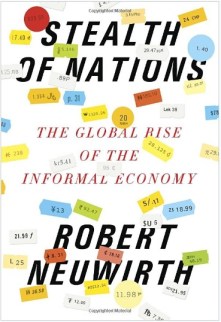
I posted just yesterday about the Informal Economy described by Robert Neuwirth as System D, where it is projected that by 2020 two thirds of the world’s workers will operate. That’s an economy almost entirely independent of the state, and the nation state structure. It all harks back to the Industrial Revolution, which spawned Marxism and the labour movement, a movement that brought communism and great intellectual struggle. We have to believe that within those workers there will be able leaders; English as a language is increasingly unifying peoples. It could be an interesting century yet!
I mentioned in passing yesterday that ‘In Africa, many tribes operate … with their own systems of justice’, though I did not have a reference. This morning, my attention was brought to a recent UN Development Program (UNDP) report entitled Informal Justice Systems. In it, the report states that ‘…80% of disputes are resolved through informal justice systems in some countries’. The claim is based on research by Ewa Wojkowska . The combination of the Informal Economy and Informal Justice is of course mesmerising. If those two beasts can find some resonance with an Informal Security apparatus, then hey presto, you have a de facto State, but not one in the conventional family of nations, rather is it more like some globalised feudalism, a million miles from Manhattan.
Bob Neuwirth’s book on the economies that operate completely independent of the State is an indictment on State effectiveness, and State Legitimacy.
In considering the concept of state legitimacy, we need to understand why is it so important? I’ve mentioned before that there are two kinds of legitimacy as I see it, an internal legitimacy and an external legitimacy. External legitimacy is that conferred upon a sovereign state by the international community, affording it standing in the community of nations, making it entitled to trade and interact in international affairs. Internal legitimacy is that internal relationship between the state and its people, wherein the state is recognised as representative, or authoritative in matters such as justice, taxation and (to a greater or lesser degree) morality.
In order to understand why legitimacy is important, we should consider what happens when it disappears. We need to consider this in respect of both internal and external legitimacy. External legitimacy is perhaps easier to consider, as there are so many well documented examples, and because the legitimating forces are clear and easily measurable; when the international community describes a country as a failed state, it is primarily in relation to its external legitimacy. Sanctions are usually the first indicator. The International Community decides, in its wisdom, that due to some breach in the rules – formal or otherwise – a State, and in particular its régime, needs to alter its behaviour in order to be considered persona grata. The State becomes isolated, trade opportunities become limited, and economic progress is retarded. This happened in Iraq, Iran, Afghanistan, North Korea, Syria, Somalia – the list goes on.
Glenn Greenwald’s most excellent series on Security and Liberty in The Guardian addresses most recently the definition of terrorism, and in particular the case of a gangland shooting where a man called Morales shot and killed an innocent 10-year-old girl by mistake. The State of New York convicted him of being a terrorist, defined by state laws as acting with ‘intent to intimidate or coerce a civilian population.’ The interpretation of the court was that Morales actions were designed to coerce the entire Mexican-American community, and were therefore terrorist. On appeal, the court not only rejected the terrorism conviction, but also sent the entire case for retrial, as the standards by which terrorist trials were conducted were different to those of non-terrorist offences.
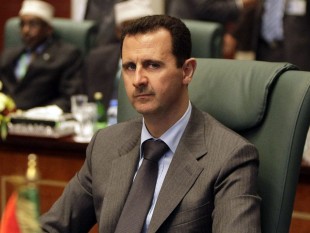
A draft declaration from talks in Marrakech on the situation in Syria from the Friends of Syria has recognisedthe opposition as ‘the legitimate representative of the Syrian people’. Which is nice for them, I guess. Not so nice, one would presume, for the president of Syria, Bashar Al-Assad and his friends. Syria has generally been on the wrong side of US foreign policy, and even when the US has needed its support, for example in the lead up to the Invasion of Iraq in 2003, the extent to which it was willing to court Syrian support was arms length and defensive. President Obama’s declaration of support for the opposition coalition yesterday was not unexpected, and is likely to hasten the demise of the ruling family in Syria, which has been in place for over forty years.
Tom Chivers in The Observer laments the demise of religion for its impact on social cohesion – and challenges that secularism needs to replace it with something else that works. I think that’s exactly what the Internet is for – new communities, new communications, new associations. The Internet, in that social sense, is the new religion.
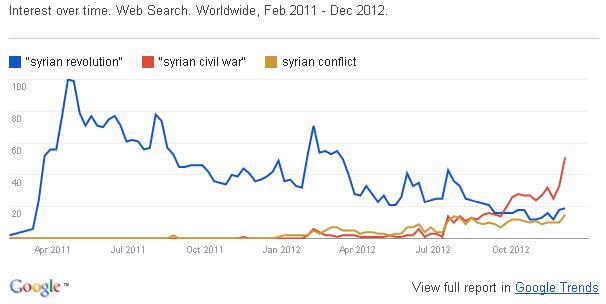
The Syrian Conflict became a Civil War on September 16th, according to Google. At, emm, about tea-time.
State Legitimacy is an amorphous thing. It’s difficult to measure, difficult to assert, and relative. Not only is the legitimacy of the state relative to other states, but it is relative across other dimensions too – relative to its citizens, or subjects, relative to its power or to the effectiveness of its power (an admittedly cyclical compare), and relative to the context of its actions. In other words, it’s tough to pin down. If we think of it another way, if we could measure state legitimacy, and we could similarly measure state illegitimacy, or the extent to which a state is failed, what would be the point at which we recognise one polarity from the other?
I stumbled upon a most excellent article called The Meaning and Measurement of State Legitimacy by Dr Bruce Gilley, formerly of Princeton University and now at Portland State. One of the most useful pieces of the article is the definition of State Legitimacy, which from my first reading appears to be interchangeable with the term political legitimacy. Gilley explores the subjects, objects and sub-types of legitimacy. Gilley then proceeds to do essentially what I have been discussing – a ‘strategy to achieve replicable cross-national measurements of legitimacy is then outlined and implemented, including a discussion of data sources and three alternative aggregation methods.’ He also has a book (right), which I’ve ordered.
While globalization generally has an impact on the role and nature of the State, there are specific components of globalization – including communications technology and the impact on community, frequency and immediacy of travel and the impact on territorial integrity – that should each be dealt with independently. One of those is the development of supranational institutions, and the extent to which they may have an impact on state legitimacy, and/or legitimacy. This can be a very legalistic argument, as it concerns itself with Public International Law, but it is a necessary foundational consideration for this part of the State Legitimacy Economy.










 State Legitimacy